

USF Researchers Explore AR for Young Learners
Researchers at the University of South Florida are studying how children can help shape augmented reality learning experiences through a new interdisciplinary project. The work brings together the USF College of Education and the Bellini College of Artificial Intelligence, Cybersecurity and Computing.
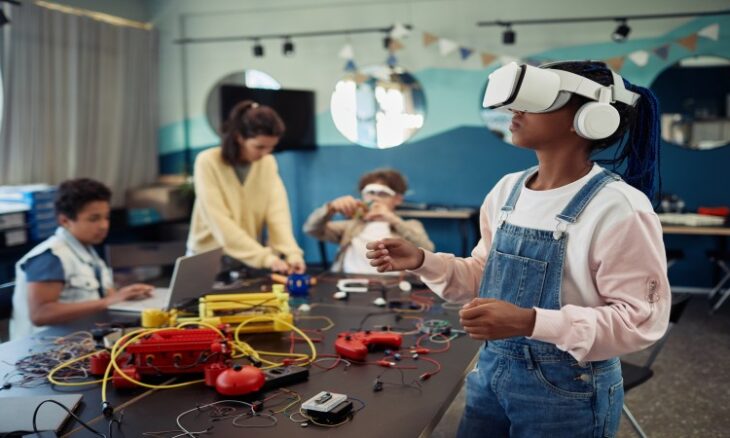
The three-year project has received a $500,000 grant from the US National Science Foundation. Researchers will investigate how to optimise augmented reality as an adaptive learning system for children. The technology combines virtual objects with the natural environment and will be tested through interactions with AR headset systems.
The project will examine children’s reflective thinking while they use the headsets. The research aims to support personalised learning through augmented reality and identify ways the technology can respond more effectively to young learners.
Julia Woodward, principal investigator and assistant professor in the Bellini College, leads the project. Her research lab has been examining how to create augmented reality experiences that are more child-friendly and appropriate for children. The work also considers the potential of AR devices for learning and engagement, while recognising that the technology has not been designed with children in mind.
The project, known as HCC: Children’s Learning Enhanced with AR and Individualised Responses, or CLEARIR, will use child participatory research and co-design. Children will take part in the research and contribute ideas to developing the AR learning experiences.
The participatory approach will also give children an educational experience through the research process. They will see how their ideas can contribute to innovation as they co-design the technology. The research will result in AR headset learning experiences specifically designed for children.
Ilene Berson, a professor in the College of Education, is also involved in the project. The research will treat children as partners in the co-design process and examine the ideas they bring to developing the technology. Their participation will shape the project’s approach to creating learning experiences for young users.
The research will use geospatial learning tasks as the testbed for the AR headset learning system. These tasks will focus on spatial and abstract thinking skills. Students will work on community planning in hurricane-prone areas and explore concepts related to rainfall distribution, hurricane swaths, wind patterns and flood zones.
The geospatial activities will provide a setting for students to work with these concepts using augmented reality. The tasks will therefore allow the researchers to examine the learning system through activities involving spatial information and abstract thinking.
The project also brings educators and computer scientists together to examine how augmented reality can support learning activities. Michael Berson, a professor in the College of Education, is part of this work. The collaboration will use technology to support children’s exploration of community challenges while developing decision-making skills.
The research will also address the knowledge and confidence children can develop through these actions as they engage with issues connected to their communities. The community planning tasks will provide the specific context for that work, using hurricane-related concepts such as rainfall, hurricane swaths, wind patterns, and flood zones.
CLEARIR combines child participatory research, co-design and geospatial learning within its study of adaptive augmented reality learning. The project will examine children’s reflective thinking as they interact with AR headset systems and will use their participation in the design process to develop learning experiences specifically for children.
Through the three-year research programme, the USF teams will study how augmented reality can support personalised learning while giving children a direct role in developing the experiences being investigated. The work will centre on geospatial learning tasks that address spatial and abstract thinking through community planning in hurricane-prone areas.